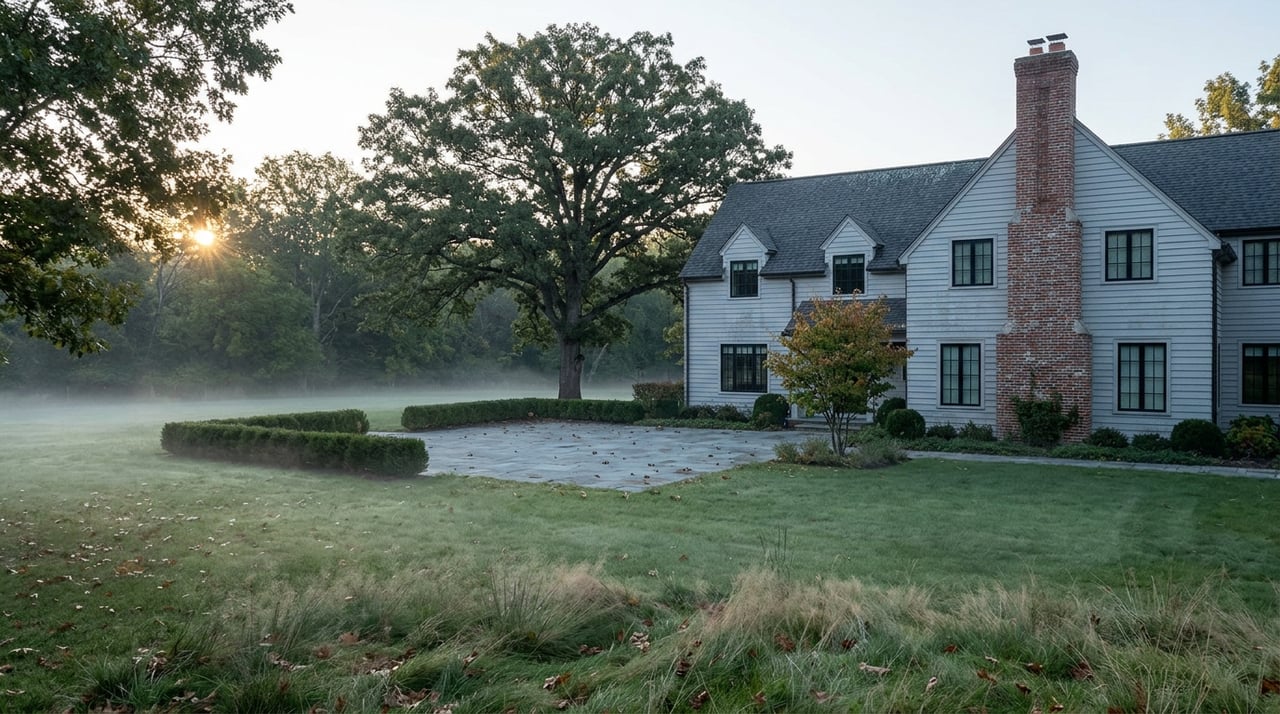
Barrington Hills Has Three Trail Systems. Here's Which Rules Apply Where.
September 24, 2026
September 24, 2026
Ride the loop off Old Sutton Road on a fall morning and the ground never changes. Same crushed limestone, same tree line, same rolling grade that made this stretch of Cook County look like horse country a century before anyone called it that. But somewhere along that loop, usually without a sign to mark it, you cross from land the public is licensed to use into land you're only welcome on because a neighbor's grandparents shook hands with a rider's club in 1937.
Most residents who've lived here a while know the feeling without knowing the mechanism. You don't need a permit to walk your dog on one segment and then suddenly you do, or you're on a trail that belongs to nobody you'd think to call. Barrington Hills doesn't have one trail network. It has three, run by three different organizations with three different rulebooks, and they happen to touch at a few specific points. Knowing where those points are changes how you use your own backyard.
The village's own equestrian heritage page describes a network of more than 150 miles of trails across 3,800 acres of forest preserve, and that number gets repeated everywhere from real estate copy to park district newsletters. What rarely gets repeated is how much of that mileage is not, legally, public at all.
The Riding Club of Barrington Hills, the volunteer nonprofit that has maintained the bulk of that network since before the village itself incorporated, states plainly on its own site that only about 65 miles of its trails sit inside Forest Preserve District of Cook County land, the segments where a county permit governs access. The rest of the network, closer to 85 miles by that math, crosses private property under an arrangement that goes back to the club's founding.
When the Riding Club formed in 1937, the club's history page explains, neighbors entered an informal agreement letting mounted members cross each other's land on horseback. That handshake, renewed generation after generation as land changed hands, is still the legal basis for most of the bridle paths in Barrington Hills today. It's also why the Riding Club is explicit that trails outside the Forest Preserve are for the exclusive use of its own members and guests, not the general public, no matter how open they look from the saddle.
Layer in a second institution and the picture gets more specific. The Barrington Hills Park District runs its own Riding Center at 361 Bateman Road, a 15-acre facility with an indoor arena, outdoor arenas, wash racks, and trailer parking that traces back to a barn the Riding Club itself built there in 1964 before donating the land to the newly formed Park District in 1972. The Park District's own site is direct about the boundary: the Riding Center sits next to the county's Spring Creek Forest Preserve trails, but "the Park District and the Cook County Forest Preserve District are separate organizations with different rules and fees." Different landlord, different paperwork, even though the fence lines touch.
Here's how the three actually break down for anyone deciding whether they can ride, walk, or bike a given stretch:
| System | Who governs it | What you need there |
|---|---|---|
| Riding Club of Barrington Hills (private trails) | RCBH, under 1937-era handshake agreements with individual landowners | RCBH membership; not open to the general public |
| Barrington Hills Park District Riding Center | The Park District (361 Bateman Road) | Your own registration or program fee with the district; it's an unsupervised facility, so you ride at your own risk |
| Spring Creek and Horizon Farm preserves | Forest Preserves of Cook County | An FPDCC Rider's License and Horse Tag ($35 a year for county residents) or a day pass, both expiring every June 30 |
Three separate landlords, three separate credentials, all within a village small enough to walk across in an afternoon.
The clearest place the three systems actually meet is Horizon Farm, and it's worth understanding how recently that connection was built.
The Forest Preserves of Cook County bought the nearly 400-acre former equestrian estate in 2013 for $14.5 million, the district's largest single land purchase since 1968, after the property fell into foreclosure. What followed was not a quiet transition. The former owners fought the sale for years, and by September 2017 the site had closed to the public again amid appellate litigation, according to Daily Herald reporting at the time. The Forest Preserves didn't regain full possession until October 2019.
From there, the reopening happened in pieces. The northern section, roughly 40 percent of the property, opened to hikers, birders, and cross-country skiers in November 2021. The rest stayed closed while crews assessed and demolished more than twenty buildings that were beyond repair. Full public access didn't arrive until December 30, 2022, when the Forest Preserves opened the southern section along with a new 1.2-mile loop trail and, critically, a spur connecting straight into the Riding Club of Barrington Hills trail to the west.
"We are pleased to announce that now, the public can fully explore Horizon Farm," Arnold Randall, the district's general superintendent, said when the site opened. What that announcement didn't spell out is that the spur itself is the exact seam where the rules change. Ride in from the Horizon Farm side and you're on Cook County land, licensed and tagged. Cross that spur onto the Riding Club's side and you've left public land for private land held together by an eighty-plus-year-old handshake, whether or not you're a member.
It's a three-year-old connection in a trail system that residents have thought of as one continuous whole for decades, which is exactly why the mental map most people carry is out of date at the one point that matters most.
The three institutions don't just have different rules, they operate on entirely different clocks. The Barrington Hills Park District's Riding Center has a Cowboy Camp with clinician Mark Lyon scheduled for September 26 through 28, a three-day program run entirely through the district's own registration, unconnected to anything the county or the Riding Club is doing that same weekend.
Meanwhile the Forest Preserves of Cook County, the largest of the three institutions by a wide margin, spent August 2026 negotiating a labor contract extension with Teamsters Local 700, a dispute the district navigated while keeping every preserve in the county, Horizon Farm included, open and operating. That's a reminder of scale: the county system running through Spring Creek and Horizon Farm answers to a countywide government and workforce, while the Riding Club answers to its own volunteer board and the Park District answers to its own elected commissioners. The village even keeps a standing Equestrian Commission, which met September 1, to sort through exactly this kind of overlap on an ongoing basis.
The county's own long-term plan for Horizon Farm, meanwhile, has been slower moving. A public presentation of the Forest Preserves' comprehensive master plan for Horizon Farm and Spring Creek was scheduled for December 13, 2023, then rescheduled with no confirmed replacement date found since. The physical trail, including that 1.2-mile loop and its spur into the Riding Club's network, has been open and in daily use for nearly four years. The paperwork governing its long-term future is still catching up.
None of this means the trails are hard to use. It means the assumption that "the trails" are one thing, governed one way, is the part worth retiring. If you're riding, check whether you're on Forest Preserve land, where an FPDCC Rider's License and Horse Tag are required, or on Riding Club land, where membership is the only credential that counts. If you're at the Park District's Riding Center, remember it's an unsupervised facility that runs on its own registration, separate from both. And if you own acreage anywhere near Spring Creek or the Riding Club's network, it's worth knowing whether a decades-old handshake agreement crosses your own property, since that history transfers with the land whether a new owner knows about it or not.
That last point is the kind of detail that surfaces during a real transaction, not before one. If you're weighing a move within Barrington Hills, adding acreage, or just want a clear-eyed read on what a property's trail access actually includes before you make an offer, Kevin Baum has spent years tracing these lines lot by lot and is glad to talk through what a specific address means for how you'll actually use the land around it.
Stay up to date on the latest real estate trends.

If this approach resonates, the next step is simple.