In Barrington Hills, the Village Doesn't Set Your Bedroom Count. Your Septic System's Age Does.
August 13, 2026
August 13, 2026
A buyer touring a five-bedroom estate on a wooded five-acre lot in Barrington Hills sees a home office with a closet and assumes it could become bedroom six with a coat of paint and a new door swing. In most suburbs, that assumption holds. In Barrington Hills, it depends on a number the listing agent probably never mentioned: the age of the home's septic distribution lines.
There is no municipal sewer system here. Most homes in the Village run on private wells and septic systems, and that single fact quietly governs almost every renovation, addition, and resale decision on the property. The Village's own code does not treat a septic system as infrastructure you either have or don't. It treats it as a ledger, and the balance in that ledger is set by how old the system is on the day you file for a permit.
Section 4-2-7 of the Village Code lays out exactly how much of an existing septic system counts toward a new bedroom or an addition. The rule is built around the age of the distribution lines already in the ground.
| Age of existing distribution lines | Credit assigned | What that means in practice |
|---|---|---|
| Under 10 years | 100 percent credit for the length in place | Adding a bedroom usually proceeds on the existing footprint |
| 10 to 20 years | 50 percent credit, unless the Village Health Officer inspects and approves more | Partial credit, often contingent on an inspection you didn't plan for |
| Over 20 years | No credit for standard distribution lines | The addition is effectively sized as if no system exists |
Chamber-style septic systems get a longer runway, with full credit under 15 years and a similar step-down after that, but the mechanism is the same: age determines how much of what's already buried counts toward what you want to build.
Here is where it bites. A home built in the early 2000s with its original septic system is now past the 20-year mark. The system may be functioning perfectly for the current bedroom count. But the moment an owner or buyer wants to convert that home office into bedroom six, the Village doesn't ask whether the tank is working. It asks how old the distribution lines are, and at that age, the answer is zero credit. The project stops being a design question and becomes a septic engineering question, and often an expensive one. The Illinois Extension service notes that a full replacement of a private on-site system can approach $10,000, and that figure is a general estimate, not a Barrington Hills-specific quote, but it gives a sense of the floor a buyer should budget for before assuming a flex room is a free upgrade.
Buyers who have purchased in unincorporated Cook County before sometimes assume the county health department handles septic review. In most of Cook County, that's correct. Barrington Hills is one of a small number of exceptions. The Cook County Department of Public Health confirms it reviews private sewage systems throughout the county, with named exceptions for incorporated Barrington Hills, Inverness, Palos Park, and South Barrington, each of which runs its own IDPH-approved septic ordinance instead.
That distinction matters more than it sounds. It means the permit history, inspection records, and credit calculations for a Barrington Hills property live with the Village, not with Cook County. A buyer who pulls county records and finds nothing hasn't confirmed a clean system. They've confirmed they looked in the wrong place. The right first call is the Village itself, not the county health department.
Septic is only half the private-utility picture. Water arrives the same way it leaves, through infrastructure the owner maintains alone. The Village recommends annual water quality testing through BACOG, county health departments, or private water companies, and periodic inspection of well tanks and pumps, since neither shows up on a visual walkthrough the way a cracked driveway does.
Estate-home inspectors working across the broader Barrington area have flagged the same gap from the other side of the transaction: private well inspection and water quality testing are described as non-negotiable due diligence on large-lot rural parcels, yet they routinely fall outside the scope of a standard inspection built for a quarter-acre suburban lot. A buyer who books a generic two-hour inspection and assumes it covered the well is often wrong, and won't find out until the water tests come back or the pump fails in the first winter.
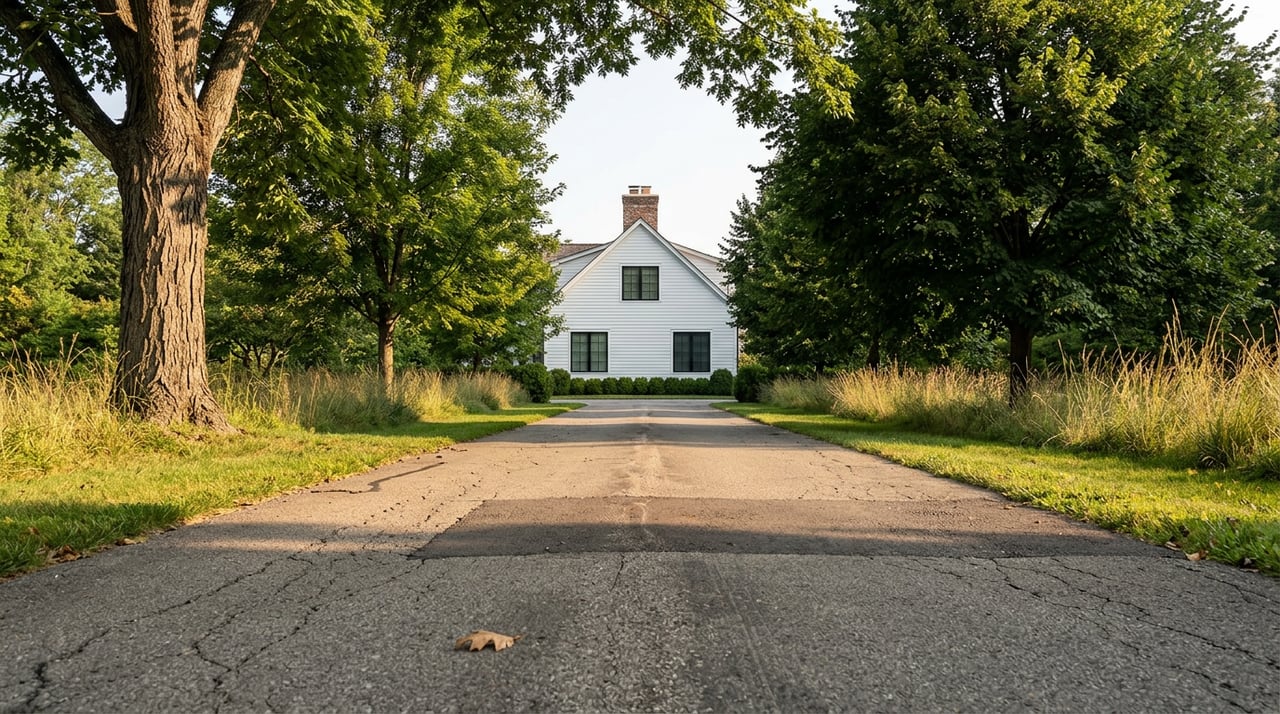
The septic ledger isn't the only cost hiding behind the acreage. Barrington Hills maintains 24.5 miles of private roads, and the Village's role in keeping them driveable is more limited than most buyers assume.
In 2026, the Village Board of Trustees awarded that year's road program bid to Schroeder Asphalt Services, Inc. Residents on private roads were invited to reach out for a quote of their own, but the Village's own notice is direct about the boundary: any work on private roads is contracted between the homeowner, or the road association, and the contractor. The Village facilitates the bidding relationship. It does not pay the bill.
That structure means the question that actually determines your carrying cost isn't whether the road out front looks maintained today. It's whether a road association exists for that stretch, whether it holds a reserve fund, and whether a special assessment is already on the horizon. None of that appears in a listing photo, and it rarely appears in a listing description either.
A buyer who wants the real picture, not the assumed one, should ask for a specific set of documents before earnest money goes hard.
None of these are exotic requests. They're the estate-property equivalent of asking for HOA documents in a subdivision. The difference is that nobody hands them to you automatically, because there's no HOA packet to trigger the conversation.
Acreage, tree canopy, and a long private approach are what sell a Barrington Hills estate at first look. They are not what determine whether you can actually use the house the way you picture using it, or what it will cost you to keep living there. That verdict comes from two systems that never make it into the listing photos: how old the septic distribution lines are relative to a 10-year and 20-year clock, and whether the road bringing you home is a public asset or a private obligation you now share with your neighbors.
A buyer who asks about acreage and view has asked half the question. A buyer who asks about septic age and road ownership status has asked the half that actually decides what the house can become.
Does every home in Barrington Hills rely on a private well and septic system? Most do. The Village confirms that most homes rely on private wells and septic systems rather than municipal water and sewer service, which is why both systems carry so much weight in a purchase decision here.
How often should a septic system be inspected or pumped? The Village recommends periodic pumping, typically every three years, along with regular inspection of well tanks and pumps. Neighboring Lake Barrington's health department guidance uses a similar window, recommending inspection at least every three years and pumping every three to five years.
Is a septic inspection legally required before selling in Barrington Hills? Illinois real estate law requires sellers to disclose known problems with an on-site system, but that disclosure relies on what the seller believes counts as a problem. A professional inspection, arranged by either party before closing, is the only way to confirm the system's actual age, condition, and remaining credit under Village code, rather than relying on a seller's good-faith estimate.
If you're weighing a purchase in Barrington Hills, or trying to price a sale on a property with a private well, septic system, or private road frontage, these are exactly the details worth getting right before you're under contract. Kevin Baum works this market street by street, and can help you pull the right records before you make an offer or list. Request your complimentary home valuation to start the conversation.
Stay up to date on the latest real estate trends.

If this approach resonates, the next step is simple.