Why Hawthorn Woods' Dark Sky Community Rules Matter
August 27, 2026
August 27, 2026
"We don't call ourselves a suburb," Hawthorn Woods chief operating officer Kim Stewart told the Kentucky League of Cities. "We call ourselves an oasis, and we are rural by design."
That line is doing more work than it sounds like at first pass. It is not a marketing slogan someone workshopped for a brochure. It is a description of a specific, still-unfinished municipal project: dimming an entire village, one property at a time, on a schedule that stretches out for years. If you have lived in Hawthorn Woods for a while, you have probably noticed that some streets go properly dark after sunset while others still glow the way any other Lake County subdivision does. That is not an accident or an oversight. It is the visible evidence of a ten-year compliance window that started running in 2019, already passed the point where every property owner was supposed to have begun, and is now closing in on its hard deadline in 2029.
In 2020, DarkSky International named Hawthorn Woods an International Dark Sky Community, only the second town in Illinois to earn the title after Homer Glen took it in 2011, and the 29th community worldwide. The recognition traces back to a Municipal Lighting Ordinance the village board adopted in September 2019, built around a simple idea the ordinance itself borrows almost word for word from DarkSky's own language: use the amount of light you need, when you need it.
What gets lost in most retellings of that story is that the ordinance did not switch anything off overnight. New construction had to comply immediately. Everyone else, meaning most of the homes already standing in the village at the time, was given five years just to begin the process and a full ten years to finish it. The village chose gradual compliance over blanket enforcement, with modest fines for property owners who never get around to it. Run that math forward from September 2019 and the five-year start deadline landed back in 2024. The ten-year finish line lands in 2029, which means Hawthorn Woods is now in the final stretch where every remaining noncompliant fixture is supposed to be on its way out, not the early, easy years when nobody expected much movement yet. The patchwork look you see walking or driving through the village after dark is not inconsistency. It is a rollout in its final phase.
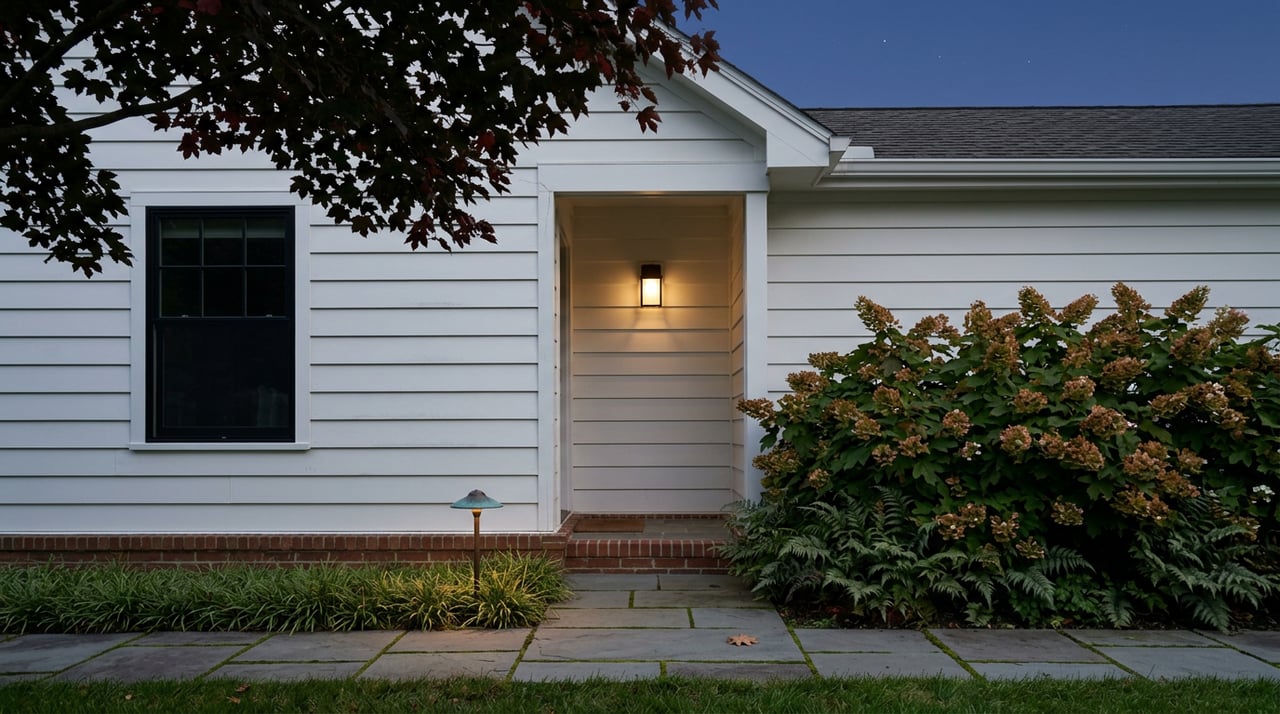
The ordinance itself gets specific in ways that matter if you are the one installing a new fixture. Low-voltage landscape lighting in residential zoning has to shut off by 10 p.m. unless it is on an automatic control tied to when the property closes for the night. Outdoor athletic field lighting is capped at 50 feet of pole height and has to point down at the field, not out toward neighboring yards. Underwater pool lighting, temporary construction lighting, and village-approved special event lighting are all carved out as exceptions. None of this reads like theater. It reads like a village government that sat down and worked through the actual fixtures people install, one category at a time.
The honest question is why a town would take on the administrative weight of phasing in a lighting code over a decade instead of just leaving well enough alone. Stewart's answer, on record with the Kentucky League of Cities, is that the tradeoff has not cost the village anything it can measure. She pointed to Hawthorn Woods' ranking as the second-safest city in Illinois and said the lighting rules have not shown up in crime or vehicle accident numbers. Mayor Dominick DiMaggio framed the same choice in terms of preserving what the village considers its defining character, telling residents at the time of the DarkSky designation that the goal was protecting the "rural nature" and "natural beauty" the village was built around.
What the darkness actually buys residents shows up in the calendar, not just the code book. The village has run stargazing classes, night photography sessions, and constellation-identification programs tied directly to the designation, framing the reduced light pollution as something to use rather than just something to comply with. Hawthorn Woods has also built a genuine reputation around its Independence Day fireworks, drawing a reported 6,000-plus attendees in recent years, a number that is notable for a village of roughly 9,000 people. For 2026, that fireworks tradition has been folded into the Party in the Park celebration, rescheduled to Saturday, September 19th, starting at 4 p.m. with a petting zoo, train rides, food vendors, axe throwing, and two live bands before the display closes out the evening. Earlier in the summer, the village ran its Concerts in the Park series every Friday from June 5 through August 14 at Community Park, giving residents a weekly excuse to be outside as the sky faded rather than heading in once the sun went down.
Dark sky status did not appear out of nowhere. A few years before the DarkSky designation, Hawthorn Woods had already picked up the Audubon International Sustainable Community Award, and the village's own resolution supporting the dark sky application leans on language that has nothing to do with stargazing at all. It describes Hawthorn Woods as sitting inside a Great Lakes flyway zone and frames the lighting ordinance partly as a way to protect migratory bird patterns that get disrupted by artificial light at night. The same instinct shows up in smaller, less publicized ways. The village runs an annual Excellence in Gardening Award, open for 2026 nominations, that recognizes residents whose yards, gardens, or landscaping integrate with the natural setting rather than fighting it, with four separate chances to win across the season.
None of these programs individually would justify calling Hawthorn Woods anything unusual. Plenty of suburbs give out a gardening ribbon or run a summer concert series. What makes the pattern worth noticing is that it repeats across parks policy, lighting code, wildlife language, and community events with enough consistency that it stops looking like coincidence and starts looking like an actual operating principle for how the village makes decisions.
If you already live here, the practical takeaway is not abstract. If your own exterior lighting predates 2019 and you have not touched it, the village's own timeline says you should already have started the process, with the full compliance deadline landing in 2029, not decades away. If you are shopping for a new fixture, the code already tells you what is and is not allowed, down to the 10 p.m. cutoff for landscape lighting. And if you have never taken the village up on one of its stargazing nights, the fact that Hawthorn Woods went to the trouble of writing a ten-year lighting ordinance means the sky above Community Park is, on a clear night, genuinely different from what you would see two towns over.
The village bet that residents would rather ease into this than have it forced on them all at once, and so far that bet appears to be holding. Whether that bet finishes paying off is still an open question, because the real test of the ordinance will not be visible until 2029, when the ten-year clock actually runs out on the last wave of properties covered by it.
If you are thinking about what a home in Hawthorn Woods is worth in a market shaped by a lot with dark, tree-lined evening skies and a village that has built real identity around protecting them, Kevin Baum can walk you through what that looks like with a complimentary home valuation, grounded in the same local detail this village runs on.
Stay up to date on the latest real estate trends.


If this approach resonates, the next step is simple.